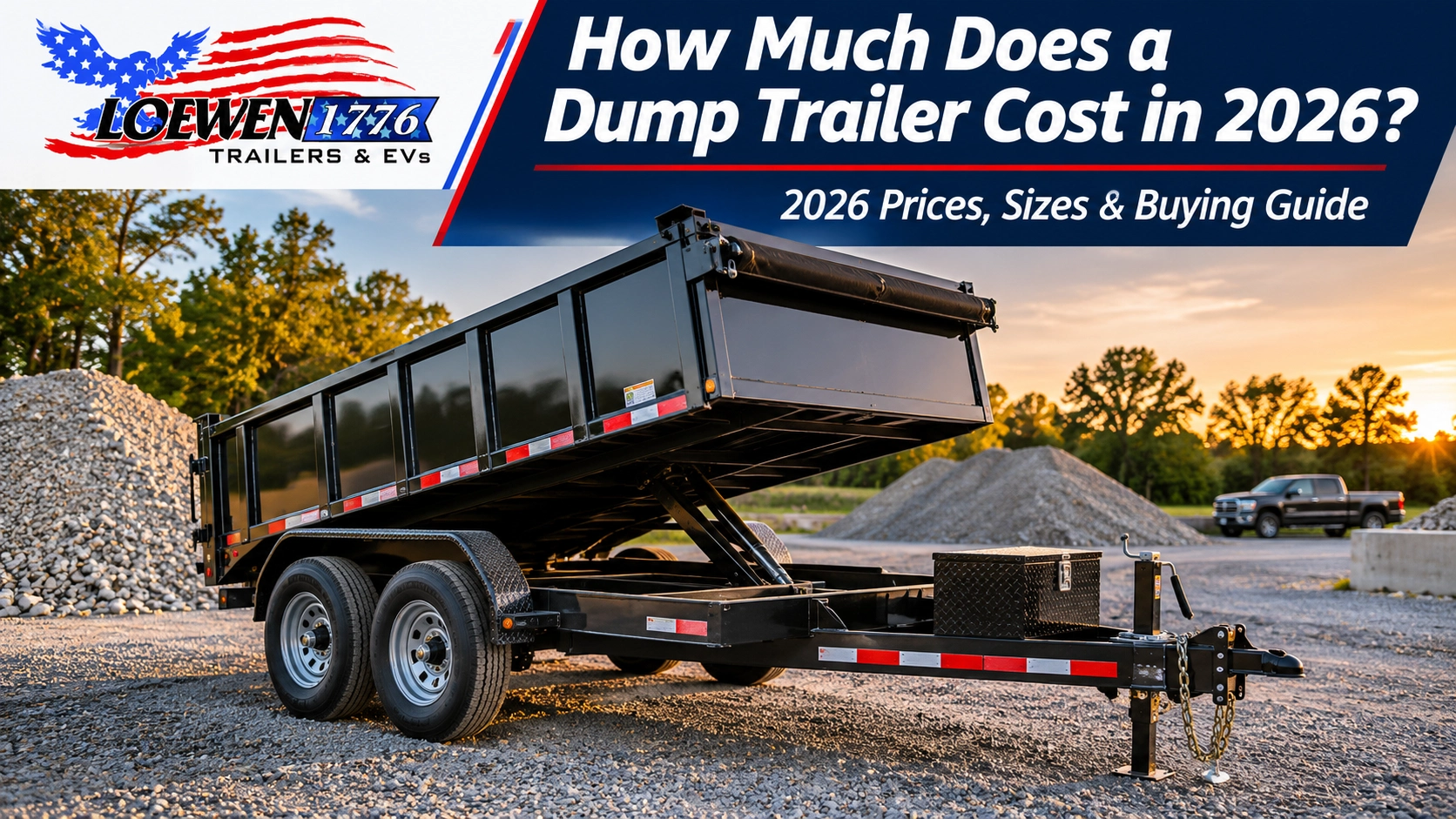
A new dump trailer will run you somewhere between $3,000 and $25,000+ in 2026 — and that range is so wide because “dump trailer” covers everything from a tiny 5×8 yard cart to a massive gooseneck hauling 30,000 pounds of gravel. The price you’ll actually pay depends on three things: bed size, weight capacity (GVWR), and what’s built into the trailer.
Here’s a quick look at where prices land right now:
| Size Category | Typical Dimensions | GVWR Range | 2026 Price Range | Best For |
|---|---|---|---|---|
| Small / Homeowner | 5’×8′ to 5’×10′ | 3,500–7,000 lbs | $2,900 – $8,100 | Yard cleanup, mulch, firewood, light renovation debris |
| Mid-Size / Contractor | 6’×10′ to 6’×12′ | 7,000–12,000 lbs | $6,000 – $9,500 | Landscaping, roofing tear-offs, general construction waste |
| Full-Size / Heavy-Duty | 7’×14′ to 7’×16′ | 14,000–17,500 lbs | $9,500 – $17,000 | Equipment hauling, excavation, commercial hauling |
| Gooseneck / Commercial | 7’×14′ and up | 14,900–30,000+ lbs | $13,000 – $35,000+ | Heavy commercial work, fleet operations, quarry/aggregate |
But that table only tells part of the story. The trailer’s sticker price doesn’t include the hitch you’ll need installed on your truck, the brake controller, registration fees, or the insurance you’ll want on a $12,000 piece of equipment sitting in your driveway. We’ll break all of that down too.
Let’s dig into what you’re really going to spend.
Dump Trailer Prices by Size — What You’ll Actually Pay
This is the section most people came here for, so let’s get right to it. We’ve pulled pricing data from dealer inventories, manufacturer MSRPs, and major retailers across the country — not just our own lot — so you’re getting the full picture.
Small Dump Trailers (5×8 to 5×10) — $2,900 to $8,100
If you’re a homeowner who needs to haul mulch, brush, renovation debris, or firewood a few times a month, this is your sweet spot. You don’t need a $15,000 trailer for weekend yard work.
At this size, you’ll find both single-axle and light tandem-axle models. Single-axle units with a 3,500 to 5,000 lb GVWR start as low as $2,700–$5,000. Step up to a 5×10 with tandem axles and a 7,000 lb rating, and you’re looking at $6,500–$8,100 from most dealers.
Brands you’ll see in this range include Carry-On, Tarter, Load Trail, and Midsota. Tractor Supply carries a few entry-level options starting around $2,700–$5,000 if you want something basic.
Tow vehicle: Any half-ton pickup (F-150, Silverado 1500, Ram 1500) handles these with no issues.
Who should skip this size: Anyone hauling daily for work. These trailers aren’t built for commercial abuse, and the small bed fills up fast when you’re running jobs.
Mid-Size Dump Trailers (6×10 to 6×12) — $6,000 to $9,500
This is where things start getting serious — and where a lot of landscapers and small contractors land. A 6×10 with a 10,000 lb GVWR gives you enough bed space and payload for mulch runs, gravel deliveries, roofing tear-off debris, and hauling small equipment like compressors or trenchers.
Most 6×10 models run $6,000–$8,500, while a 6×12 with a 10K–12K rating pushes into the $7,000–$9,500 range. You’re getting tandem axles, electric brakes on both axles, a hydraulic lift (usually scissor at this price point), and a barn-door or combo gate.
Brands in this range include Hawke, PJ Trailers (their D5 utility starts around $6,499), Big Tex (6×10 models around $8,199), and RawMaxx.
Tow vehicle: A half-ton truck works for lighter loads. Once you’re regularly maxing out a 10K trailer, you’ll want a 3/4-ton (F-250, Silverado 2500, Ram 2500).
Who should consider this size: Landscapers hauling mulch and debris daily, handymen with varied job sites, farmers moving feed and supplies, and anyone starting a junk removal side business.
Full-Size Dump Trailers (7×14 to 7×16) — $9,500 to $17,000
This is the workhorse category — the trailer most contractors, construction crews, and serious haulers end up buying. A 7×14 with 14,000 lb GVWR and a telescopic lift is the single most popular configuration in the country, and prices for that setup range from about $9,500 to $16,000 depending on the brand, build quality, and features.
At our dealership here at Loewen 1776 Trailers & Truck Bodies, our dump trailers in this size range run from $11,485 to $14,764. We carry Horizon Trailers, RawMaxx, and Southland models — all with competitive pricing and financing options to fit your budget.
Across the broader market, here’s what you’ll see:
| Brand | 7×14 Price Range | 7×16 Price Range | GVWR |
|---|---|---|---|
| PJ Trailers | $7,698 – $10,499 | $10,499+ | 14,000–16,000 lbs |
| Big Tex | $10,499 – $12,699 | $11,499+ | 14,000–15,400 lbs |
| RawMaxx | $11,485 – $15,199 | $12,015+ | 14,000–17,500 lbs |
| MAXX-D | $8,998 – $15,998 | $15,488 – $16,488 | 14,000–17,500 lbs |
| Diamond C | $14,493+ (LPT) | $16,998+ | 14,900–24,000 lbs |
| Southland | $11,619+ | — | 16,000–17,597 lbs |
Tow vehicle: You need a 3/4-ton or 1-ton truck for these. Period. An F-350, Silverado 3500, or Ram 3500 is ideal. Some lighter 14K models can work behind a 3/4-ton, but check your truck’s tow rating against the trailer’s GVWR before you buy.
Who should consider this size: General contractors hauling construction debris and equipment, excavation crews, roofing companies running full tear-offs, and hauling businesses that need to move skid steers and mini-excavators.
Gooseneck and Heavy-Duty Dump Trailers — $13,000 to $35,000+
Once you’re past the 14,000 lb mark and working with 16-foot or longer beds, you’re typically looking at gooseneck hitches. A gooseneck hitch mounts through your truck bed instead of at the bumper, which gives you better weight distribution, tighter turning, and significantly more stability at high payloads.
Gooseneck dump trailers start around $13,000 for a basic 7×14 configuration and climb quickly. A Diamond C LPT gooseneck with 18,000 lb GVWR starts around $17,314. Their Pacesetter 16-footer runs about $22,988. And their dual-tandem WDT model — the one quarry and demolition crews use — starts at $34,048.
Tow vehicle: One-ton trucks only. Many commercial gooseneck trailers require a dually (dual rear wheels) for proper weight handling.
Who should consider this: Fleet operators, demolition companies, heavy excavation contractors, and anyone regularly hauling 10+ tons. If you’re not sure whether you need a gooseneck, you probably don’t — a bumper-pull 7×14 covers most jobs.
What Makes One Dump Trailer Cost Twice as Much as Another
You’ve probably noticed that two 7×14 dump trailers can cost $8,000 and $16,000. Same bed size. Same basic job. So what’s the difference?
It comes down to how the trailer’s built — and those construction differences directly affect how long it’ll last, how much you’ll spend on repairs, and what it’s worth when you sell it in five years.
| Component | Budget Build ($8,000–$10,000) | Quality Build ($12,000–$16,000+) | Price Difference |
|---|---|---|---|
| Frame | Tube steel or light channel; can trap moisture and rust from the inside out | Heavy I-beam or engineered channel; easier to inspect, weld, and repair | $500 – $2,000 |
| Lift System | Scissor hoist; more moving parts, more frame stress | Telescopic cylinder; fewer parts, better lifting power, easier service access | $500 – $2,000 |
| Floor & Sides | 12-gauge or 10-gauge steel; dents easier, thinner welds | 7-gauge steel; handles rocks, concrete, and heavy impacts without deforming | $300 – $800 |
| Axles | Standard axles with basic bearings | Dexter axles with sealed oil-bath bearings; last significantly longer | $400 – $1,000 |
| Paint/Coating | Single-coat paint; chips on the first gravel load, rust follows fast | Multi-stage powder coat with primer; holds up for years of daily use | $300 – $500 |
| Wiring | Exposed connectors; first thing to corrode and short out | Routed through the frame with sealed connections; far fewer roadside failures | $200 – $400 |
| Hydraulics | Power-up, gravity-down; the bed drops under its own weight, which can be uneven | Power-up, power-down; controlled descent, more consistent operation | $300 – $600 |
Here’s the real talk: if you’re using a dump trailer once or twice a month for light homeowner work, a well-made budget trailer will serve you fine for years. But if you’re running it daily for commercial jobs — loading rock, demolition debris, wet soil — those construction differences add up fast. A cheap floor that dents after 6 months of hauling concrete isn’t a bargain. It’s a repair bill waiting to happen.
The sweet spot for most working contractors? A mid-range build from a brand like PJ, Big Tex, MAXX-D, RawMaxx, or Southland. You’re getting solid construction without paying the premium-brand markup. Browse our dump trailer inventory to see what’s available in that range right now.
The Costs Beyond the Sticker Price
This is the part nobody talks about — but it can add $1,500 or more to your actual out-of-pocket cost in the first year. Before you budget based on the trailer’s sale price alone, factor these in:
| Cost Item | What You’ll Pay | Notes |
|---|---|---|
| Bumper-pull hitch installation | $200 – $500 | If your truck doesn’t already have a receiver hitch rated for the trailer’s weight |
| Gooseneck hitch installation | $400 – $800+ | Requires cutting into the truck bed and mounting hardware |
| Brake controller + wiring | $140 – $400 | Required for any trailer with electric brakes — which is every tandem-axle dump trailer |
| Spare tire and mount | $50 – $300 | You don’t want to find out you forgot this on the side of the highway |
| Registration and title | $50 – $300+ | Varies wildly by state — check with your local DMV |
| Insurance | $200 – $600/year | Based on trailer value and intended use; commercial use costs more |
| Annual maintenance | $300 – $800/year | Bearing grease, tire rotation, brake adjustment, hydraulic fluid check, electrical connections |
| Towing mirrors | $4 – $450 | Clip-on mirrors run $4–$50; permanent replacements run $150–$450 per pair |
So what does a dump trailer REALLY cost in year one?
Let’s say you buy a $12,000 trailer. Add $400 for a brake controller install, $75 for registration, $300 for insurance, $200 for a spare tire setup, and $300 for your first maintenance round. That’s $13,275 — about 10% more than the sticker price.
It’s not a dealbreaker for anyone. But it’s better to know upfront than to get surprised after the check clears.
And once the trailer’s on your lot, ongoing costs are pretty manageable. You’re looking at roughly $500–$1,400 per year for insurance and maintenance combined, depending on how hard you run it. That’s a fraction of what a dump truck costs to operate. For routine maintenance needs, our service team at Loewen 1776 Trailers & Truck Bodies can keep your trailer in working shape.
New vs. Used Dump Trailers — The Real Math
Buying used sounds great on paper. A 3-year-old trailer that listed for $12,000 new might sell for $8,000–$9,000. That’s real savings. But used trailers come with risks that can eat those savings fast if you’re not careful.
How Dump Trailers Depreciate
New trailers lose about 15–20% of their value the moment you tow them off the lot. After that first hit, they drop roughly 10% per year. So here’s what the depreciation curve looks like on a $12,000 trailer:
| Age | Estimated Value | Depreciation from New |
|---|---|---|
| Brand new | $12,000 | — |
| Driven off the lot | $9,600 – $10,200 | 15–20% |
| 1 year old | $8,600 – $9,200 | ~25–28% |
| 3 years old | $7,000 – $8,000 | ~33–42% |
| 5 years old | $5,500 – $6,500 | ~46–54% |
Those are estimates based on industry depreciation data from CostHelper. Real-world prices depend on brand, condition, and how hard the previous owner used it.
When Buying Used Makes Sense
Used can be a smart play when you’re buying a backup trailer that won’t see daily use, when you’re on a strict cash budget and don’t want to finance, or when you find a well-maintained unit from a private owner who only used it for light work. A contractor selling a 3-year-old trailer because he upgraded to a gooseneck? That could be a solid buy.
When New Is Worth the Money
On the flip side, buying new makes more sense when the trailer’s your primary work tool and you need it reliable every single day, when you want a warranty backing the hydraulics, axles, and frame, when you need specific features or dimensions that are hard to find used, and when financing makes the monthly payment manageable.
At Loewen 1776 Trailers & Truck Bodies, we offer multiple financing options through Sheffield Financial, Mazo Capital, RTO Streamline, and C3 Rentals — so buying new doesn’t mean draining your bank account.
What to Check Before Buying Used (10-Point Inspection)
If you do go the used route, inspect these things carefully — or hire someone who knows trailers to look at it for you:
- Hydraulic system — Look for leaks around the cylinder, pump, and lines. Cycle the bed up and down. Hesitation or uneven lifting means trouble.
- Frame — Check for cracks, bends, or heavy rust along the main beams, especially near the hitch and under the bed.
- Floor — Press hard on the floor plates. Thin spots, holes, or heavy dents mean the floor’s been hammered. Replacement isn’t cheap.
- Axles and bearings — Grab each wheel and rock it. Any play means worn bearings. Check for grease leaks at the hubs.
- Brakes — Pull the drums and check pad thickness. Worn-out brakes are common on work trailers and cost $300–$600 to replace per axle.
- Tires — Look at tread depth AND sidewall condition. Cracked sidewalls from sun and age are just as dangerous as worn tread.
- Electrical — Test every light. Turn signals, brake lights, running lights, clearance markers. Bad wiring is the #1 cause of trailer failures.
- Gate and hinges — Open and close the tailgate. Bent hinges or a gate that doesn’t latch properly means the load shifts when you dump.
- Paint and rust — Surface rust on the body is cosmetic. Structural rust on the frame, crossmembers, or floor is a different story entirely.
- Title and VIN — Make sure the VIN on the trailer matches the title. No title? Walk away.
A $4,000 used dump trailer that needs $2,000 in hydraulic work and $600 in brake repairs isn’t a deal. It’s a $6,600 trailer with no warranty and someone else’s problems.
How to Finance a Dump Trailer (With Real Monthly Payments)
Most dump trailer dealers — including us — offer financing because paying $12,000+ in cash isn’t realistic for everyone. And for a lot of buyers, financing a work trailer makes solid business sense when the trailer generates income.
Typical dump trailer financing runs 60 to 84 months with interest rates between 7% and 15% depending on your credit. Most lenders want 10% down. Here’s what that looks like at different price points:
| Trailer Price | Down Payment (10%) | 60-Month Payment | 72-Month Payment | Total Paid (72 mo) |
|---|---|---|---|---|
| $8,000 | $800 | ~$155/mo | ~$138/mo | ~$9,936 |
| $10,000 | $1,000 | ~$194/mo | ~$172/mo | ~$12,384 |
| $12,000 | $1,200 | ~$232/mo | ~$207/mo | ~$14,904 |
| $15,000 | $1,500 | ~$291/mo | ~$258/mo | ~$18,576 |
Estimates based on 10% APR. Your actual rate depends on credit history, down payment, and lender.
A few things worth knowing about trailer financing:
Business buyers can write it off. If you’re using the trailer for your business, the IRS Section 179 deduction lets you deduct the full purchase price in the year you buy it. Talk to your accountant about whether that applies to your situation — for a lot of contractors and landscapers, it makes the math strongly favor buying new rather than used.
Rent-to-own is an option too. Companies like RTO Streamline offer rent-to-own programs with lower barriers to entry. You’ll pay more over the life of the agreement than traditional financing, but it’s an option if your credit isn’t where you’d like it to be.
Pre-approval helps at the dealer. Walking into a dealership knowing your budget and payment ceiling puts you in a much stronger position. Loewen 1776 Trailers & Truck Bodies, you can start the process through our finance page before you visit.
Which Size Dump Trailer Do You Actually Need?
Buying too much trailer wastes money. Buying too little means a second purchase down the road. Here’s a decision matrix that matches your actual situation to the right trailer — and the right budget:
| Your Situation | Recommended Size | Budget Range | Tow Vehicle You’ll Need |
|---|---|---|---|
| Homeowner — yard waste, mulch, DIY projects | 5×8 or 5×10 | $2,900 – $8,100 | Half-ton pickup (F-150, Silverado 1500, Ram 1500) |
| Landscaper — daily mulch, soil, debris runs | 6×10 or 6×12 | $6,000 – $9,500 | Half-ton to 3/4-ton |
| General contractor — mixed materials, light equipment | 7×14 | $9,500 – $15,000 | 3/4-ton to 1-ton (F-250/F-350) |
| Heavy construction — demolition, excavation, large equipment | 7×16 or gooseneck | $12,000 – $25,000+ | 1-ton truck, possibly dually |
| Junk removal / hauling business | 7×14 with 3-foot sides | $11,000 – $16,000 | 1-ton truck |
| Farm / ranch — feed, fencing, general property maintenance | 6×10 or 6×12 | $6,000 – $9,500 | Half-ton to 3/4-ton |
GVWR — What It Actually Means
You’ll see “GVWR” on every dump trailer listing. It stands for Gross Vehicle Weight Rating, and it’s the maximum total weight the trailer can safely carry — including the weight of the trailer itself.
So if a trailer has a 14,000 lb GVWR and the empty trailer weighs 4,000 lbs, your actual payload capacity is 10,000 lbs. That’s what you can load into the bed before you’re over the limit.
Why this matters for your wallet: if you’re hauling wet topsoil (which runs about 2,200 lbs per cubic yard), a 7×14 trailer with 24-inch sides holds roughly 5 cubic yards. That’s around 11,000 lbs of soil — which means you need at least a 14K GVWR trailer to carry it legally and safely. Buy a 10K trailer thinking it’s “good enough,” and you’ll either be running half-loads (wasting time and fuel) or overloading it (risking fines, blown tires, and a voided warranty).
Bottom line: figure out the heaviest material you’ll haul regularly, then buy enough GVWR to handle that load plus a cushion. You can always haul less. You can’t safely haul more.
Check out our full dump trailer inventory to find the size and GVWR that matches your work.
Dump Trailer Brands and What You’re Paying For
Not every brand builds the same quality at the same price point. Here’s an honest breakdown of where the major brands sit in the market — not a ranking of “best” to “worst,” because the right brand depends entirely on what you need and what you’re willing to spend.
| Tier | Brands | Typical Price Range | What You Get |
|---|---|---|---|
| Value | Carry-On, Tarter, Iron Bull, Texas Pride, Hawke | $2,700 – $10,000 | Solid basic construction, fewer standard features, shorter or limited warranties. Good for homeowners and light-use buyers. |
| Mid-Range | PJ Trailers, Big Tex, RawMaxx, MAXX-D, Load Trail, Southland, Horizon | $7,000 – $16,500 | Stronger frames, better finish quality, longer warranties, more standard features (tarp kits, wireless remotes, ramp packages). The sweet spot for working contractors. |
| Premium | Diamond C, Aluma (aluminum) | $8,599 – $35,000+ | Engineered frames, premium coatings, advanced features, higher resale value. Diamond C uses telescopic hoists and in-house engineered beams. Aluma uses all-aluminum construction — lighter and rust-proof, but 50–80% more expensive than steel. |
At Loewen 1776 Trailers & Truck Bodies, we carry brands across the value and mid-range tiers — including RawMaxx, Horizon Trailers, and Southland — because that’s where most of our customers get the best combination of build quality and price. We’re not going to sell you a $30,000 trailer when a $12,000 one does the job.
One thing worth knowing: the brand name matters less than the specific model’s construction. A well-specced mid-range trailer with an I-beam frame, Dexter axles, and powder-coat finish will outlast a stripped-down premium model with the bare minimum features. Don’t just buy the logo — look at what’s underneath it.
How to Get the Best Deal on a Dump Trailer
You wouldn’t pay sticker price on a truck without negotiating, and the same logic applies here. A few ways to save real money:
Shop during fall and winter. Trailer demand peaks in spring when construction season kicks off. Dealers sitting on inventory through November, December, and January are more motivated to move units — and you’ll often find the best sale pricing of the year.
Compare dealer pricing vs. factory direct. Some manufacturers like Texas Pride sell factory-direct, which can save 20–25% over dealer pricing on the same trailer. The trade-off? You might need to arrange transport, and you won’t have a local dealer for warranty service.
Ask about in-stock vs. custom order. Trailers already on the lot often come with better pricing than custom-ordered units. The dealer already has money tied up in that inventory, and they’d rather sell it than let it sit. Plus, you drive away with it today instead of waiting 8–12 weeks.
Bundle the deal. If you’re buying a trailer plus options (tarp, ramps, spare tire), ask about package pricing. Dealers have more room to negotiate when you’re adding accessories to the sale.
Look at demo or floor models. These are trailers that have been hooked up to trucks at shows or used for test dumps. They’re technically “used” but often have zero actual work miles on them — and they’ll be priced below new.
Ready to see what’s available? Browse our current dump trailer inventory or give us a call at (270) 716-8827 to talk about what you need.
Frequently Asked Questions
How much does a 7×14 dump trailer cost?
A new 7×14 dump trailer typically costs between $9,500 and $16,000, depending on the brand, GVWR, lift system, and features. Budget models with scissor lifts start in the $8,000–$10,000 range, while premium builds with telescopic cylinders, 3-foot sides, and upgraded axles push past $15,000. At Loewen 1776 Trailers & Truck Bodies, our 7×14 models start around $11,485.
What’s the cheapest dump trailer worth buying?
You can find new dump trailers starting around $2,700–$3,000 for a basic 5×8 single-axle model. Brands like Tarter and Carry-On sell entry-level units through retailers like Tractor Supply. They’ll handle light homeowner work just fine — mulch, leaves, small renovation debris. Just don’t expect them to survive daily commercial use. If you’re hauling for work, spending $6,000+ on a proper tandem-axle build will save you money in the long run.
How much does it cost per month to finance a dump trailer?
Monthly payments typically range from $138 to $300+ depending on the trailer’s price, your down payment, credit score, and loan term. A $12,000 trailer with 10% down on a 72-month term runs about $207/month at 10% APR. Most lenders offer terms from 60 to 84 months.
Do I need a special license to tow a dump trailer?
In most states, a standard driver’s license covers towing a dump trailer for personal use. Commercial use gets more complicated — some states require a CDL (Commercial Driver’s License) for combined vehicle weights over 26,000 lbs, and commercial registration and insurance requirements vary. Check your state’s DMV website for specific rules, especially if you’re hauling for business.
What size truck do I need to pull a dump trailer?
It depends on the trailer’s GVWR. A 7,000 lb single-axle trailer works behind most half-ton pickups (F-150, Silverado 1500, Ram 1500). Tandem-axle trailers in the 10,000–14,000 lb range need a 3/4-ton truck at minimum (F-250, Silverado 2500). Full-size 14,000+ lb trailers — especially loaded near capacity — really call for a 1-ton truck (F-350, Silverado 3500, Ram 3500). Always check your truck’s specific tow rating against the trailer’s GVWR before buying. The trailer’s GVWR, not its empty weight, is the number that matters.
How long do dump trailers last?
A well-built dump trailer with regular maintenance can last 15 to 20+ years. The frame and body will outlast everything else if they don’t rust through. Hydraulic components, brakes, tires, and bearings are the wear items — budget $300–$800 per year for maintenance and they’ll keep running. The biggest longevity killer? Skipping greasing and ignoring small hydraulic leaks until they become big ones.
Are dump trailers a good investment for a side business?
They can be, if you price your services right. A $12,000 dump trailer financed at $207/month starts generating ROI with just a few hauling jobs per month. Junk removal services in most areas charge $300–$600 per load. Landscapers save by hauling their own materials instead of paying delivery fees. If you’re doing 10+ hauls per month, the trailer pays for itself within a year or two. The key is buying the right size — don’t overspend on a 7×16 gooseneck when a 7×14 bumper pull handles your jobs just fine.
What’s the difference between a scissor lift and a telescopic dump trailer?
Scissor lifts use a hinged steel mechanism under the bed — they’re more affordable (typically $500–$2,000 less) and provide strong, stable lifting. Telescopic cylinders are a single front-mounted hydraulic piston that extends vertically — they have fewer moving parts, handle unevenly loaded beds more effectively, and are easier to maintain and service. Scissor lifts are standard on budget and mid-range models. Telescopic cylinders are preferred for commercial use because they put less stress on the trailer’s frame over time.
Should I buy a steel or aluminum dump trailer?
Steel is the standard choice and costs significantly less. Aluminum trailers weigh less (which means higher payload capacity for the same GVWR) and won’t rust but they cost 50–80% more than comparable steel models. For most buyers, a quality steel trailer with good paint or powder coating is the practical choice. Aluminum makes sense if you’re hauling corrosive materials, need to maximize payload, or live in a salt-heavy climate where rust is a constant battle.
Can I negotiate dump trailer prices?
Yes, dealer pricing on trailers has room for negotiation, especially on in-stock units. Your best negotiating power comes from shopping during the off-season (fall and winter), comparing prices across multiple dealers, buying add-ons with the trailer (bundle pricing), and being ready to buy on the spot. Don’t expect massive markdowns — trailer margins aren’t as fat as you might think but $500–$1,000 off list price isn’t unusual, especially on units that have been sitting on the lot for a while.