You need your trailer’s VIN, and you’re standing in the driveway staring at a steel frame wondering where it’s hiding. Maybe the DMV needs it for registration. Maybe you’re about to buy a used trailer and want to verify it’s not stolen. Or maybe your insurance agent just asked for it and you’ve got no idea where to look.
Don’t worry — you’re not the first person to crawl around a trailer with a flashlight trying to find a tiny metal plate. Let’s get you to the right spot fast, then cover everything else you might need to know about trailer VINs.
The Quick Answer
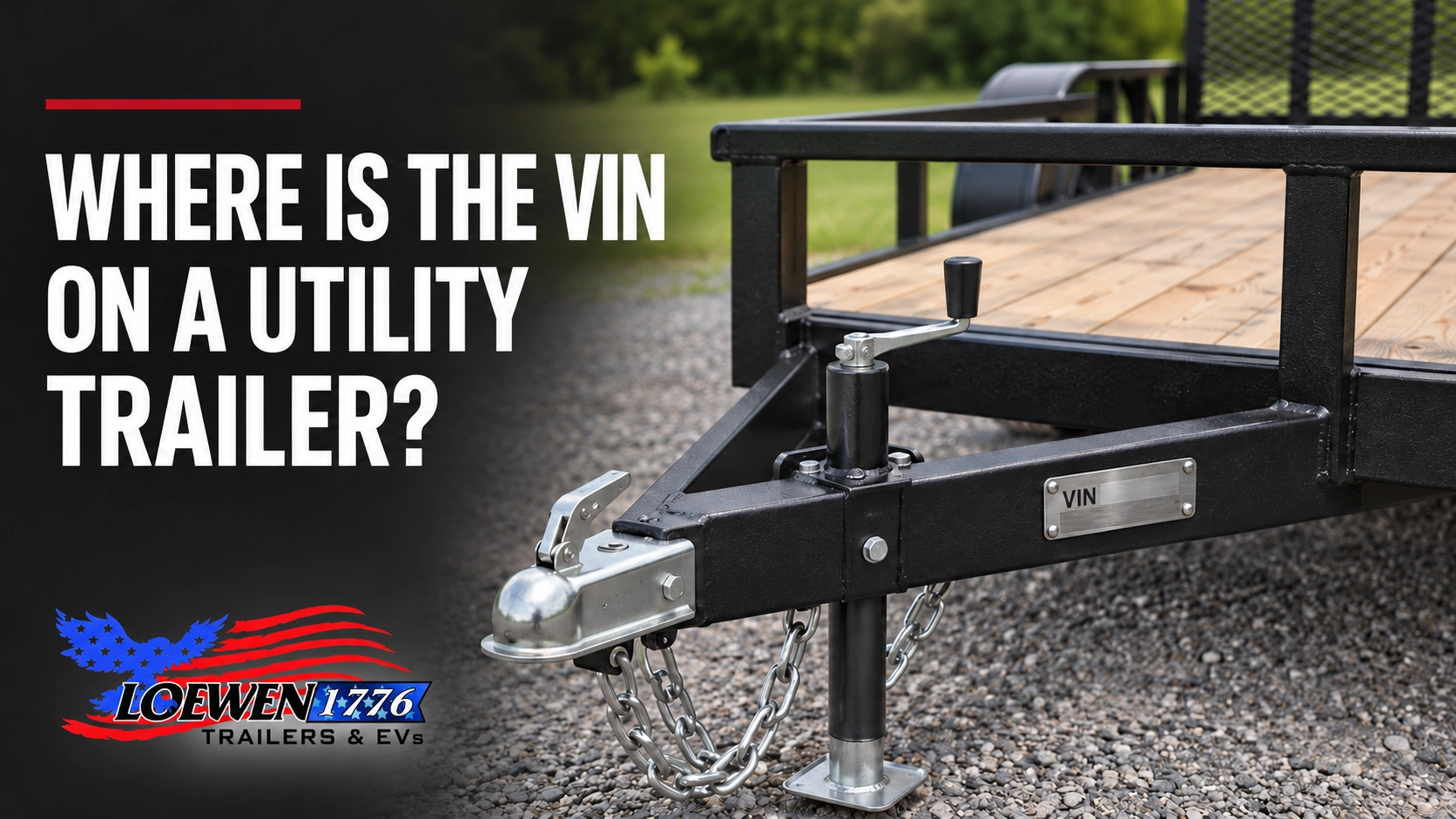
On most utility trailers, the VIN is on a metal plate riveted to the tongue — right near the coupler where the trailer hooks to your hitch. That’s the spot about 80% of the time.
If it’s not on the tongue, check the front left (driver-side) frame rail. The federal certification label — which also shows the VIN — is required by law to be on the forward half of the left side of the trailer, visible from the outside without moving any parts.
Three places to check, in order:
- Tongue/A-frame — metal plate near the coupler
- Driver-side frame rail — stamped into the steel or on a riveted plate near the front
- Federal certification label — white sticker or riveted tag on the forward left side
Found it? Great. If you’re still looking — or you want to know how to read that VIN, check if a trailer’s stolen, or figure out what to do when the VIN’s missing — keep reading.
VIN Locations by Trailer Type
Here’s the thing most people don’t realize: VIN placement varies depending on what kind of trailer you’re dealing with. A utility trailer and a dump trailer don’t put the VIN in the same spot, and enclosed cargo trailers are a different story altogether.
| Trailer Type | Primary VIN Location | Secondary Location | Watch Out For |
|---|---|---|---|
| Utility / Flatbed | Tongue, near the coupler | Front driver-side frame rail | Small trailers (4×6, 5×8) often have it on the actual tongue beam |
| Dump Trailer | Inside of the frame rail, near the hydraulic jack | Near the jack assembly at the front | The VIN is NEVER on the dump bed — the bed moves, so VINs go on the fixed frame |
| Enclosed / Cargo | Driver’s side front wall (exterior) | Inside a front cabinet or wall panel | Some have it inside the entry door or on the door frame |
| Car Hauler / Equipment | Driver-side frame rail near the front corner | Tongue (like a utility trailer) | Heavier equipment trailers may have it lower on the frame |
| Gooseneck / Fifth-Wheel | On the neck, close to the coupler plate | Frame rail near the neck junction | Don’t confuse the neck plate with the hitch manufacturer’s plate |
| Boat Trailer | Tongue or frame (similar to utility trailers) | Front left sidewall if there’s a fender | Salt corrosion is common — the VIN may need cleaning |
One common mistake with dump trailers: people look all over the dump bed and can’t find anything. That’s because VINs are always placed on a part of the trailer that doesn’t move. The bed lifts up and down, so the manufacturer puts the VIN on the fixed frame underneath or beside the hydraulic components.
3 Places to Look on Any Trailer (And How They’re Different)
There are actually three different things on your trailer that might show the VIN, and they’re not the same thing. Knowing the difference saves you time and helps you give the right information to the DMV, your insurance company, or a buyer.
The VIN Plate
This is a metal plate or tag — usually aluminum — riveted, welded, or permanently bonded to the tongue, A-frame, or front frame rail. It typically shows the VIN, GVWR (Gross Vehicle Weight Rating), GAWR (Gross Axle Weight Rating), and the date of manufacture.
This is what most people think of when they hear “VIN plate,” and it’s usually the easiest to find.
The Frame Stamp
Some manufacturers stamp or etch the VIN directly into the steel frame — usually on the tongue beam or a frame member near the front. It’s not on a separate plate; the numbers are literally pressed into the metal.
Frame stamps are extremely durable. They’ll last as long as the frame itself. The downside? They can rust over and become hard to read, especially on older trailers that live outside year-round.
The Federal Certification Label
This one’s required by federal law under 49 CFR Part 567. It’s a white label (sometimes a riveted metal tag) that every trailer manufacturer in the U.S. must place on the forward half of the left side of the trailer. It has to be visible from outside without moving any part of the trailer.
The certification label includes more than just the VIN. You’ll also find the manufacturer’s name, the date of manufacture, GVWR, GAWR for each axle, tire and rim specifications, and a statement that the trailer meets Federal Motor Vehicle Safety Standards (FMVSS).
Here’s how they compare side by side:
| Feature | VIN Plate | Frame Stamp | Federal Certification Label |
|---|---|---|---|
| What it is | Metal plate/tag with VIN and specs | VIN stamped directly into the steel | White label with FMVSS compliance info |
| Typical location | Tongue, A-frame, or front frame rail | Tongue beam or frame member near front | Forward half of the left side |
| Info included | VIN, GVWR, GAWR, manufacture date | VIN only (sometimes partial) | Manufacturer, date, GVWR, GAWR, tire specs, FMVSS statement |
| How it’s attached | Riveted, welded, or bonded | Part of the frame itself | Riveted or permanently affixed (removal destroys it) |
| Durability | Can corrode, loosen, or fall off | Very durable but can rust over | Can fade, peel, or be damaged by weather |
Pro tip: If the VIN plate on the tongue is damaged or unreadable, check for the frame stamp or the federal certification label. They’re backup copies, essentially, and one of the three is usually still legible.
VIN Locations by Manufacturer
Different manufacturers put the VIN in slightly different spots. If you know who built your trailer, this table narrows down exactly where to look.
We’ve verified these locations from each manufacturer’s official documentation — owner’s manuals, FAQ pages, and support resources.
| Manufacturer | Where to Look | Source / Notes |
|---|---|---|
| Big Tex | Front left side of the trailer, near the tongue | Owner’s manual confirms. Tag also shows GVWR, GAWR, tire specs, and manufacture date. |
| PJ Trailers | Bumper pull: inside the tongue. Dump: driver side of dump body. Gooseneck: on the riser near the jack handle. | Last 7 digits (serial) also stamped in tongue or welded inside frame. Replacement stickers available through PJ’s VIN Request Form. |
| Load Trail | Driver’s side near front (VIN sticker) | May be relocated on special configurations. VIN starts with 4ZE. |
| Sure-Trac | Tongue or forward driver-side frame | If the sticker is unreadable or missing, contact your nearest Sure-Trac dealer for a replacement. |
| Carry-On | Driver’s side tongue or front of the frame. Enclosed models: front corner of driver-side wall. | Sold at Lowe’s and Tractor Supply. White/gray sticker — color varies by trailer age. |
| Karavan | Front of the trailer, where the tongue meets the frame. 2009+ models: VIN also etched into the side rail. | VIN starts with 186 or 5KT. |
| Horizon Trailers | VIN/data plate near the hitch | Horizon confirms this on their official blog. If you bought a Horizon UTZ model from a dealer like Loewen 1776 Trailers & Truck Bodies, that’s where you’ll find it. |
| RawMaxx | Front left frame rail | Standard placement for their utility trailer line. |
A quick note on “left side” and “driver’s side.” When trailer manufacturers say “left side,” they mean the driver’s side — as in, the left side when you’re sitting in the tow vehicle looking forward. This matches the federal requirement that the certification label goes on the “forward half of the left side.”
It trips people up because if you’re standing behind the trailer looking at it, your left is actually the trailer’s right (passenger side). Always think of it from the driver’s seat perspective.
How to Read Your Trailer VIN (The 17-Character Breakdown)
Every trailer VIN manufactured since 1981 follows a standardized 17-character format. Each position tells you something specific about the trailer — where it was made, who made it, the model year, and its unique serial number.
Here’s what each section means:
| Position(s) | What It’s Called | What It Tells You | Example |
|---|---|---|---|
| 1–3 | World Manufacturer Identifier (WMI) | Country of origin + manufacturer | 16V = Big Tex (USA), 4ZE = Load Trail |
| 4–7 | Vehicle Descriptor Section (VDS) | Trailer type, body style, length | Varies by manufacturer |
| 8 | Axle Configuration | Number of axles | 1 = single axle, 2 = tandem, 3 = triple |
| 9 | Check Digit | Mathematical validation number | Calculated to verify the VIN is authentic |
| 10 | Model Year | Year of manufacture | Letter or number — see the chart below |
| 11 | Plant Code | Manufacturing facility | Number or letter assigned by the manufacturer |
| 12–17 | Vehicle Identifier Section (VIS) | Sequential production/serial number | Unique to each trailer built |
The Model Year Code (Position 10)
This is the one people look up most often. The 10th character in the VIN tells you what year the trailer was manufactured, but it’s not a simple number. It follows a rotating code that cycles every 30 years:
| Code | Year | Code | Year |
|---|---|---|---|
| A | 2010 | L | 2020 |
| B | 2011 | M | 2021 |
| C | 2012 | N | 2022 |
| D | 2013 | P | 2023 |
| E | 2014 | R | 2024 |
| F | 2015 | S | 2025 |
| G | 2016 | T | 2026 |
| H | 2017 | V | 2027 |
| J | 2018 | W | 2028 |
| K | 2019 | X | 2029 |
Five letters are never used in VINs: I, O, Q, U, and Z. They’re excluded because they look too much like the numbers 1, 0, and 2.
How to tell which 30-year cycle you’re in: Look at position 7 in the VIN. If it’s a number (0–9), the trailer is from the 1980–2009 cycle. If it’s a letter, it’s from the 2010–2039 cycle.
The Check Digit (Position 9) — Why It Matters
Position 9 is a mathematically calculated number that validates the entire VIN. It’s not random. The check digit is computed using a specific formula applied to every other character in the VIN.
Why should you care? Because if someone alters a VIN — changes even a single character — the check digit won’t match anymore. That’s how VIN fraud gets caught. Any legitimate VIN decoder tool will flag a failed check digit, which is a major red flag when buying a used trailer.
VIN vs. Serial Number: What About Older Trailers?
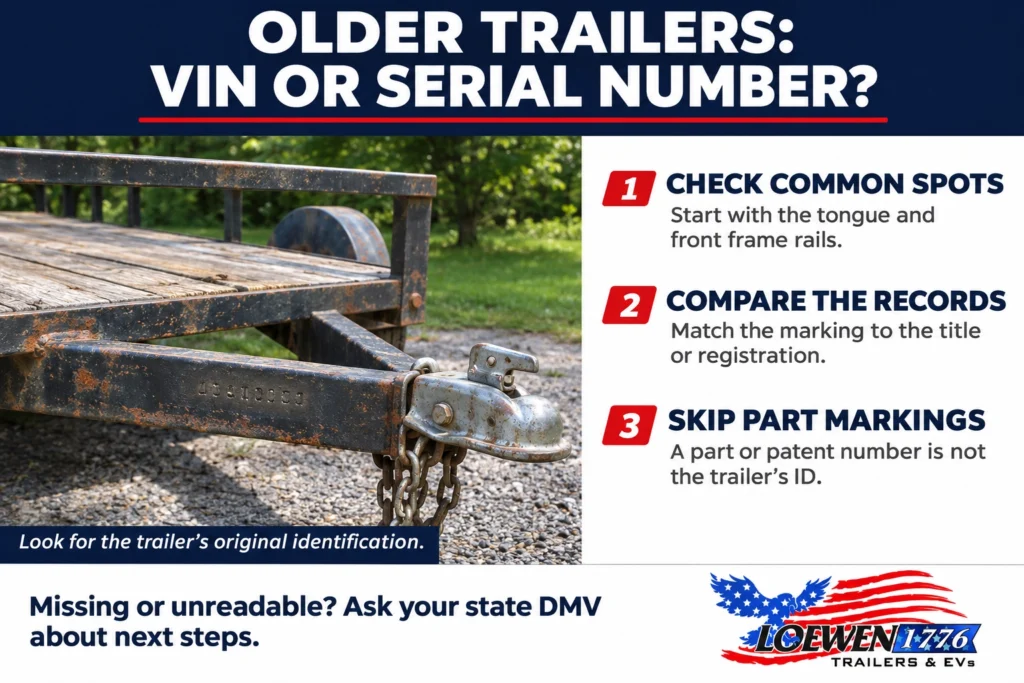
If you’re dealing with a trailer built before 1981, things work differently. The standardized 17-character VIN format didn’t exist yet. Before 1981, each manufacturer used its own numbering system — some embedded useful info (year, length, model), and others just used sequential production numbers with no context at all.
For trailers made before 1981, the manufacturer’s serial number IS the VIN as far as your state’s DMV is concerned.
Where to find serial numbers on pre-1981 trailers:
- Passenger-side tongue rail (often stamped on top)
- Driver-side tongue
- Frame rail leading to the hitch
- Inside a cabinet or entry screen door
- Under layers of paint — sometimes you need to carefully remove old paint to reveal stamped numbers
One common mistake: Some older trailers have a patent number from Marvel stamped on the tongue. Marvel supplied parts (axles, couplers) to many trailer manufacturers, and their patent stamp gets mistaken for a serial number all the time. It’s not your VIN — it’s a parts manufacturer’s marking.
A heads-up about the DMV: Some DMV employees aren’t familiar with pre-1981 serial number formats and may insist on a modern 17-character VIN. If that happens, you’ll need to go through your state’s VIN assignment process (covered in the next section).
What to Do If the VIN Is Missing or Unreadable
There are a few reasons a trailer might not have a readable VIN:
- Built before VIN standards (pre-1981 or earlier)
- Homemade or shop-built (no manufacturer VIN was ever assigned)
- VIN plate corroded, fell off, or was damaged
- VIN was deliberately removed — and yes, that’s a red flag for theft
If the VIN is just hard to read because of rust or corrosion, try cleaning it before assuming it’s gone.
How to Clean a Corroded VIN Plate
Start gentle and work your way up. The last thing you want to do is destroy the stamped characters by being too aggressive.
- Soapy water + plastic brush — scrub the VIN area, wipe dry, repeat until cleaning stops helping
- Steel wool — dry the area first, scrub with steel wool, wipe with a damp rag
- Steel-bristle brush — apply more pressure than steel wool, but keep it controlled
- Power drill with a steel brush bit (last resort) — position the bit’s edge against the VIN area and brush with LIGHT pressure
What NOT to do:
- Don’t use heavy pressure with power tools — one hard pass can destroy stamped characters for good
- Don’t use chemical rust removers on VIN stamps — they can dissolve the shallow impressions
- If the VIN is on a riveted plate, don’t remove the plate — photograph it in place
- If you can’t make it readable, stop. Trying to alter a VIN — even with good intentions — is a federal crime
Getting a State-Assigned VIN
If the VIN is truly gone or if the trailer never had one — you’ll need your state to assign a new one. Here’s how the process generally works:
- Contact your county title office or state DMV
- Bring the trailer in for inspection (the inspector confirms the trailer exists and checks for any hidden or removed VIN)
- The inspector assigns and permanently affixes a state-issued VIN plate, usually on the tongue or front frame rail
- Apply for a title using the new state-assigned VIN
The specifics and fees vary by state:
| State | Who Does the Inspection | Fee | Typical Wait Time |
|---|---|---|---|
| Kentucky | Transportation Cabinet, Rebuilt Dept. | Not listed | Requires Form TC96-169 (notarized), mailed to Frankfort |
| Tennessee | County Clerk or THP Officer | $4 | 1–2 weeks |
| Texas | TxDMV Inspector | $0–$5 | 1–3 weeks |
| Ohio | OSHP or County Title Clerk | $0 | 1–2 weeks |
| Georgia | County Tag Office | $0 | Same day–1 week |
| Florida | HSMV Inspector | $0 | 1–3 weeks |
Kentucky’s Process (Step by Step)
Since Loewen 1776 Trailers & Truck Bodies serves customers throughout Kentucky and the surrounding region, here’s the exact Kentucky process:
- Complete Form TC96-169 (Application for Motor Number or Vehicle Identification Number)
- Get it signed and notarized
- Provide notarized proof of ownership — bill of sale, title, registration, an affidavit, or a court order
- Write a notarized statement explaining why the trailer has no VIN
- List where the trailer can be inspected — name, address, and phone number of the person who has the trailer
- Mail the complete package to: Transportation Cabinet, Rebuilt Department, PO Box 2014, Frankfort, KY 40602-2014
It’s a mail-in process, not a walk-in — so plan for some turnaround time.
A word of warning: Never use a VIN from a scrapped, totaled, or abandoned vehicle on your trailer. That’s title fraud — a felony in every state — and it IS detectable during the inspection process.
Red Flags: VIN Tampering and Stolen Trailers
This isn’t the fun part of the article, but it might be the most important — especially if you’re shopping for a used trailer.
Here’s the reality: over 100,000 small trailers are stolen every year in the United States, according to Pro-Vigil. The average theft takes roughly two minutes, even with chains and wheel locks. And because many states don’t require trailer registration, stolen trailers are tough to track down and easy to resell.
Removing a VIN label from a trailer is a federal crime, per the National Association of Trailer Manufacturers (NATM). But that doesn’t stop everyone.
A Real Case: The $287,000 VIN Fraud Scheme
In 2024, a man in Florida was arrested for selling 23 semi-trailers with fraudulent or altered VINs. Total value: over $287,000. He sold all 23 to a single buyer, and the paperwork appeared to match at the time of sale. The fraud wasn’t caught until later when VIN irregularities were flagged during routine checks. Law enforcement recovered 18 of the 23 trailers.
The lesson? VIN fraud isn’t hypothetical. It happens, and it doesn’t always get caught at the point of sale.
Warning Signs to Watch For
| Red Flag | What It Could Mean | Risk Level |
|---|---|---|
| Grinding or sanding marks around the VIN area | Someone tried to remove the original VIN | 🔴 Very High |
| Fresh paint or new welds near the VIN plate | Covering up tampering evidence | 🔴 Very High |
| Uneven, misaligned, or amateurish-looking characters | VIN was re-stamped (not factory work) | 🔴 High |
| VIN doesn’t match the seller’s documents | Mismatch between plate and title/registration | 🔴 High |
| Seller won’t share the VIN before you show up | They’re hiding something | 🔴 High |
| VIN plate is loose, bent, or partially attached | May have been removed and replaced | 🟡 Moderate–High |
| Price is way below market value | Common sign of stolen goods | 🟡 Moderate–High |
| VIN has wrong number of characters (not 17) | Could be pre-1981, or could be a fake VIN | 🟡 Moderate |
| Minor surface corrosion but still readable | Normal wear — verify against title records | 🟢 Low |
Before you buy any used trailer, run the VIN through NICB’s free VINCheck tool (covered in the next section). It takes 30 seconds and could save you thousands.
If you’re buying from a reputable dealer, they’ve already done this due diligence. But if you’re buying private-party — especially from a Craigslist or Facebook Marketplace listing — a VIN check is non-negotiable.
Free VIN Check Tools
You don’t need to pay for a VIN check to get useful information. These free tools cover theft records, manufacturer specs, recall notices, and title history.
Government and Nonprofit Tools
| Tool | What It Checks | Good to Know |
|---|---|---|
| NICB VINCheck (nicb.org/vincheck) | Theft reports + insurance salvage/flood records | 100% free — run by the National Insurance Crime Bureau. Limit: 5 searches per 24 hours. |
| NHTSA VIN Decoder (vpic.nhtsa.dot.gov) | Manufacturer, model, year, specs | Works for trailer manufacturers registered with NHTSA. Great for verifying what a trailer actually is. |
| NHTSA Recall Check (nhtsa.gov/recalls) | Open safety recalls | Covers trailer-specific recalls. Worth checking before buying. |
| NMVTIS (vehiclehistory.bja.ojp.gov) | Title history, salvage/junk/flood branding | Coverage for trailers is limited, but it’s free and worth a shot. |
Free Private Tools
| Tool | What It Shows | Limits |
|---|---|---|
| VinCheck.info | Title records, theft, salvage, recalls | 5 free checks per day. May not cover all trailers. |
| FaxVin.com | VIN decoder + year code reference | Decoder is free; full history report is paid. |
| VINAudit.com | Basic VIN info | Free lookup; detailed report costs extra. |
About NICB VINCheck specifically: It checks whether a vehicle was reported stolen but not recovered, or was reported as a total loss by an insurance company (salvage, flood, etc.). It only searches participating NICB member insurance companies — not law enforcement databases. A clean result doesn’t guarantee a clean history, but a flagged result is a definite red flag.
For commercial trailers and semi-trailers, NICB directs you to BigRigVIN.com.
When You’ll Actually Need Your Trailer VIN
Your VIN isn’t just a random number on a plate — it’s the key to nearly every official interaction you’ll have with your trailer. Here’s when it comes up:
Registration and titling. Every state that requires trailer registration needs the VIN. In Kentucky, all trailers require a title regardless of size. The annual registration fee for a trailer towed by a passenger vehicle is $19.50.
Insurance. Your insurer needs the VIN to issue a policy. No VIN, no coverage.
Buying a used trailer. This is where the VIN matters most for your wallet. Run it through NICB VINCheck and the NHTSA VIN Decoder before you hand over money. You’re checking for theft records, recall history, and whether the specs on the trailer match what the seller claims.
Selling your trailer. The buyer will need the VIN for title transfer. Having it ready — along with a clean title — speeds up the sale.
Warranty claims. The manufacturer needs your VIN to look up your trailer’s build record and verify warranty coverage.
Recall checks. NHTSA uses the VIN to identify which specific trailers are affected by safety recalls. This is especially important for axle, brake, and lighting recalls.
Theft reporting. If your trailer gets stolen, the VIN is what police enter into the stolen vehicle database. Without it, recovery becomes much harder. Write down your VIN and store it separately from the trailer — in your phone’s notes, a file at home, or with your vehicle documents.
Financing. If you’re financing a trailer purchase, the lender uses the VIN to verify the asset they’re lending against.
FAQ
Where is the VIN on a small utility trailer?
Same spot as a full-size utility trailer — on the tongue near the coupler, or on the front driver-side frame rail. Even 4×6 and 5×8 trailers follow the same VIN placement rules. On very small trailers, the VIN plate is sometimes right on the tongue beam itself because there’s not much frame rail to work with.
Can a trailer VIN be on the right side?
It shouldn’t be. Federal law (49 CFR Part 567) requires the certification label on the forward half of the left (driver’s) side. The VIN plate might end up on the right side on rare occasions, but that would be non-standard. If the only VIN you can find is on the right side, double-check that it matches the title before relying on it.
What if my trailer’s VIN plate fell off?
Don’t panic — but don’t ignore it either. Check for a frame stamp (VIN pressed directly into the steel) or the federal certification label as backups. If you can’t find the VIN anywhere, you’ll need to go through your state’s VIN assignment process to get a new one. Some manufacturers, like PJ Trailers, also offer replacement VIN stickers if you contact them with proof of ownership.
How many digits is a trailer VIN?
A standard trailer VIN is 17 characters — a mix of letters and numbers. If your trailer has fewer than 17 characters, it was likely manufactured before 1981 when the standardized format took effect. The letters I, O, Q, U, and Z are never used in VINs because they look too much like numbers.
Is the VIN the same as the serial number?
Not exactly. The VIN includes a serial number (the last 6 digits, positions 12–17), but it also includes manufacturer info, model year, and a check digit for fraud detection. For trailers made before 1981, the manufacturer’s serial number serves as the VIN since there was no standard format yet.
Can I look up a trailer VIN for free?
Yes. NICB VINCheck (nicb.org/vincheck) checks for theft and salvage records at no cost — up to 5 searches per day. The NHTSA VIN Decoder (vpic.nhtsa.dot.gov) is also free and shows manufacturer specs and model details. Neither requires an account to use.
Do all states require trailer registration?
No. Registration requirements vary by state and often depend on the trailer’s weight (GVWR). Kentucky requires a title for all trailers, plus registration with an annual fee of $19.50 for trailers towed by passenger vehicles. Other states exempt lightweight utility trailers entirely. Check with your local DMV for your state’s specific rules.
What should I do if the VIN on a used trailer doesn’t match the title?
Walk away. A VIN mismatch between the physical trailer and the seller’s paperwork is one of the biggest red flags for fraud or theft. At minimum, it means something’s wrong with the documentation. Don’t complete the purchase until the discrepancy is fully resolved — and if the seller can’t explain it, don’t complete the purchase at all.
How do I find the year of my trailer from the VIN?
Look at the 10th character. It’s a letter or number that corresponds to the model year. For example, “T” = 2026, “S” = 2025, “R” = 2024, and so on. Use the year code chart in this article to decode yours. The cycle repeats every 30 years.
Can someone steal my identity with my trailer VIN?
A VIN alone isn’t enough for identity theft in the traditional sense — it doesn’t contain your personal information. However, sharing your VIN publicly could allow someone to create fraudulent documents (like a fake title) using your trailer’s VIN. Keep it private when possible, and always verify VINs when buying.